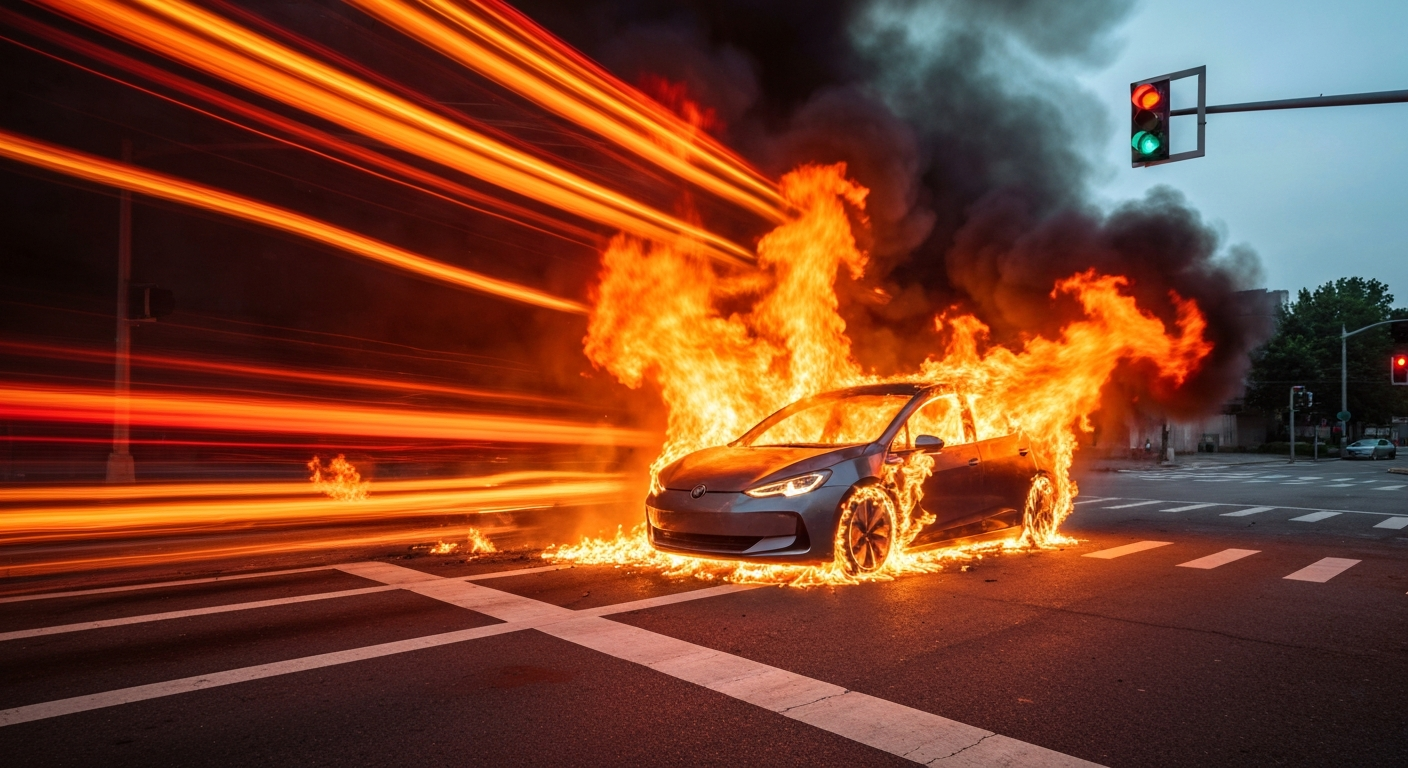

Colorado's I-70 Tunnels Face a Growing Threat: EV Fires That "Don't Go Out"
How the Colorado Department of Transportation is sounding the alarm—and why tunnel safety demands new solutions.
The Colorado Department of Transportation (CDOT) is raising serious concerns about the danger of electric vehicle fires in the state's critical I-70 mountain tunnels, including the iconic 1.7-mile-long Eisenhower-Johnson Memorial Tunnel. As EV adoption accelerates nationwide—driven in part by state mandates—the firefighting challenges posed by lithium-ion battery fires are becoming impossible to ignore.
According to a report from MotorBiscuit, CDOT officials have been remarkably candid about the scale of the problem. Jori Ernst, CDOT's emergency manager, put it bluntly: "What we're worried about is the EV fires. They don't go out. We're not going to be able to fight them."
The Unique Danger of an EV Fire
An EV fire is fundamentally different from a traditional vehicle fire. When even a single lithium-ion battery cell overheats, it triggers a phenomenon known as thermal runaway—a chain reaction where heat spreads from cell to cell in a cascading, self-sustaining inferno. The results are devastating:
- Temperatures exceeding 1,200°F
- Release of flammable gases such as methane and hydrogen, which intensify the blaze
- Explosions that send shrapnel and debris in all directions
- Thick, toxic smoke that is hazardous not only to motorists but also to the emergency responders trying to save them
In an open-air environment, these fires are already extraordinarily difficult to manage. Inside a confined tunnel? The scenario becomes exponentially more dangerous. Toxic gases have nowhere to dissipate. Heat builds with no escape. Visibility drops to zero in seconds.
CDOT fire program manager Peter Igel has openly wrestled with the tactical dilemma: "Do we prevent the exposures and let those fires burn? Or do we try to suppress the fire? If the fire is in the tunnel, hopefully, we can move the burning vehicle outside."
Colorado Is Investing Millions—But Is It Enough?
To its credit, CDOT has dramatically upgraded its firefighting capabilities in the Eisenhower-Johnson tunnel. What was once a single old fire truck has been replaced with:
- Multiple dedicated firefighters stationed at the tunnel
- A $700,000 pumper truck and a smaller backup pumper
- A $25 million automated spray system
- Four firefighters available at all times, trained to detect fires in seconds
Since 2017, there have been five vehicle fire incidents in the Eisenhower tunnel, leading to road closures lasting up to 14 hours. Fortunately, no fatalities have resulted from these fires—but as the number of EVs on the road grows, officials know the odds are shifting.
Paul Fox, manager of CDOT's tunnels, and his team are actively exploring strategies to handle EV fires and safely extract burning electric vehicles from the tunnels. But even with tens of millions of dollars in infrastructure, the fundamental problem remains: lithium-ion battery fires burn for hours and resist conventional suppression methods.
A Practical Solution: The EV Fire Blanket
This is exactly the kind of scenario that drove us at FireFibers to develop our line of EV fire blankets. While water-based suppression systems struggle against thermal runaway, a purpose-built fire blanket can:
- Contain the fire by starving it of oxygen
- Dramatically reduce toxic smoke and gas emissions, protecting both motorists and first responders
- Buy critical time for evacuation and emergency response
- Be deployed in seconds by trained personnel—no specialized equipment required
For tunnel operators, fleet managers, parking garages, fire departments, and even individual EV owners, having an EV fire blanket for sale from a trusted manufacturer like FireFibers isn't a luxury—it's becoming a necessity.
Our blankets are engineered to withstand the extreme temperatures generated by lithium-ion battery fires and are designed for rapid deployment in exactly the kinds of confined, high-stakes environments that keep CDOT officials up at night.
The Conversation We Need to Have
The push toward electric vehicles brings real environmental benefits, but as Colorado's experience makes clear, we cannot afford to treat fire safety as an afterthought. The dangers extend beyond fire itself—heavier EV weights cause additional wear and tear on road infrastructure, and the sheer difficulty of suppressing these fires creates cascading risks for everyone sharing the road.
States mandating EV adoption have a responsibility to simultaneously invest in the safety infrastructure needed to manage the risks. And organizations at every level—from state DOTs to local fire departments to commercial fleet operators—need practical, proven tools to respond when the worst happens.
If you're looking for an EV fire blanket for sale, contact FireFibers today to learn about our products and find the right solution for your needs. Whether you're protecting a tunnel, a parking structure, a dealership, or your own garage, we're here to help you prepare for the fire that "doesn't go out."
Stay safe. Stay prepared. Stay covered with FireFibers.