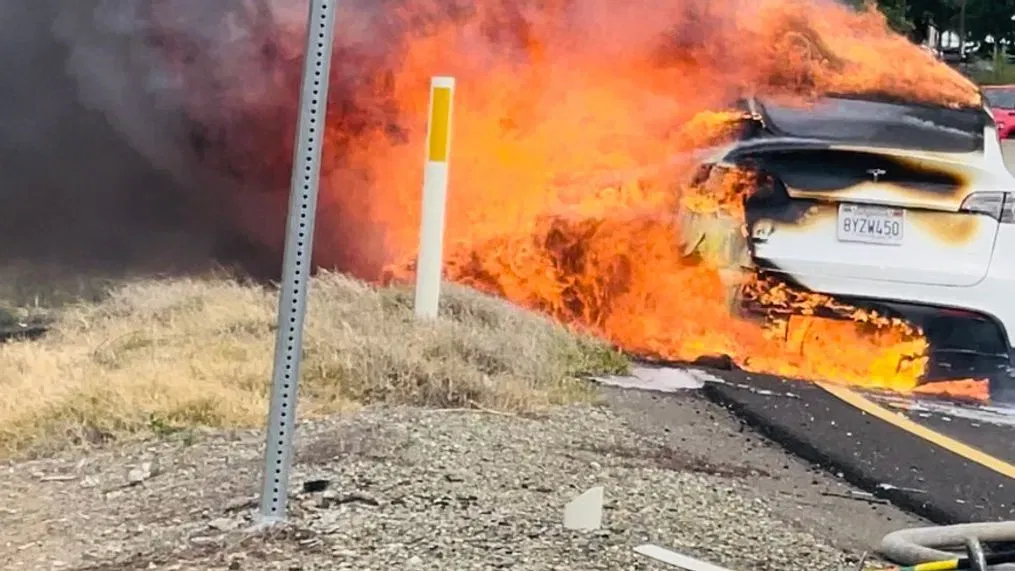

EV Fires Don't Play by the Rules — And That Changes Everything
Why lithium-ion battery fires demand a completely different approach to vehicle fire safety
Electric vehicles are safer than gas-powered cars in many ways — but when they do catch fire, all bets are off. A recent article from Autoblog dives deep into one of the most misunderstood dangers of EV ownership: the unique and unpredictable behavior of lithium-ion battery fires. And what they found should be on every fleet manager's, fire department's, and EV owner's radar.
Here's a summary of the key takeaways — and what they mean for anyone thinking seriously about fire safety.
These Fires Don't End When the Flames Go Out
With a traditional gas-powered vehicle, the playbook is straightforward: extinguish the flames, cool the hot spots, clear the scene. Done.
EV fires are a completely different animal. When a lithium-ion battery pack enters thermal runaway, the fire isn't just burning on the surface — it's raging deep inside the battery cells through a self-sustaining chemical reaction. That reaction continues generating heat internally even after visible flames are gone.
The result? A fire that can reignite hours later without any visible warning. Gases vent, pressure builds, and the moment oxygen re-enters the equation, the scene can go from "under control" to dangerous in an instant.
For first responders, this means an EV fire scene isn't a single event — it's an ongoing hazard that has to be monitored long after the initial emergency response concludes.
The Water Problem Is Real
Water remains the primary tool for fighting EV fires, but the volume required is staggering. The article cites a documented Tesla battery fire that required roughly 24,000 gallons of water over 40 minutes — up to 40 times more water than a conventional car fire.
Why? EV battery packs are mounted low in the chassis and sealed in durable, water-resistant casings. That engineering is excellent for everyday driving performance and wet-weather safety. But in a fire scenario, it creates a significant barrier between firefighters and the actual source of the heat.
Interestingly, 2025 tests showed that simply tipping a burning EV onto its side gave responders better access to the battery pack and reduced suppression time significantly. It's a powerful reminder that vehicle design doesn't just affect how a car drives — it determines how difficult it is to manage when something goes catastrophically wrong.
The Fire Blanket Problem
Here's where we at FireFibers want to be completely transparent, because this is directly relevant to what we do.
The article points out that conventional fire blankets have been used in attempts to smother EV fires by cutting off oxygen. On paper, it sounds logical. In reality, it can make things significantly worse.
A standard fire blanket traps the toxic, flammable gases being produced inside the battery. Those gases continue to build pressure underneath. The moment the blanket is moved or disturbed and fresh air is introduced, the conditions are ripe for a sudden and potentially explosive reignition.
This is exactly why FireFibers developed our lithium-ion specific fire blankets with this failure mode in mind. Not all fire blankets are created equal, and the difference between a blanket designed for general fire suppression and one engineered specifically for the unique chemistry of lithium-ion thermal runaway can be the difference between containment and catastrophe. If you're relying on a generic fire blanket for EV fire scenarios, you may be creating more danger than you're preventing.
The Good News (Yes, There Is Some)
Here's the important context the article provides: EV fires are far less common than fires in gas-powered vehicles. The data shows approximately:
- 25 fires per 100,000 EVs
- ~1,500 fires per 100,000 internal combustion vehicles
That's a massive difference. EVs are significantly less likely to catch fire in the first place.
But — and this is the critical "but" — when they do catch fire, everything about the response is harder. More time. More water. More caution. More specialized equipment. And a danger window that extends hours beyond what anyone would expect.
What This Means Going Forward
EV adoption is accelerating rapidly, and fire behavior is one of the critical challenges the industry is still adapting to. The article raises a question we think about every single day at FireFibers:
As more electric vehicles hit the road, is the infrastructure — and the strategy — keeping up with the risks that come with them?
Right now, the answer is: not fast enough. Fire departments need specialized training. Storage and transport protocols for fire-damaged EVs need to be updated. And the tools being used — from hose lines to fire blankets — need to be purpose-built for lithium-ion chemistry, not borrowed from the old playbook.
Be Prepared, Not Scared
This isn't about fearmongering. EVs are a remarkable technology, and statistically, they're less fire-prone than the vehicles they're replacing. But "less likely" doesn't mean "risk-free," and when the risk does materialize, being prepared with the right knowledge and the right equipment is everything.
If you're a fleet operator, a fire department, a dealership, a parking structure manager, or an EV owner who takes safety seriously, now is the time to make sure your fire suppression strategy accounts for the realities of lithium-ion battery fires — not the assumptions.
Want to learn more about how FireFibers' lithium-ion fire blankets are engineered differently for exactly these scenarios? Contact our team today to find the right solution for your needs.
FireFibers — Purpose-built protection for the fires of tomorrow.