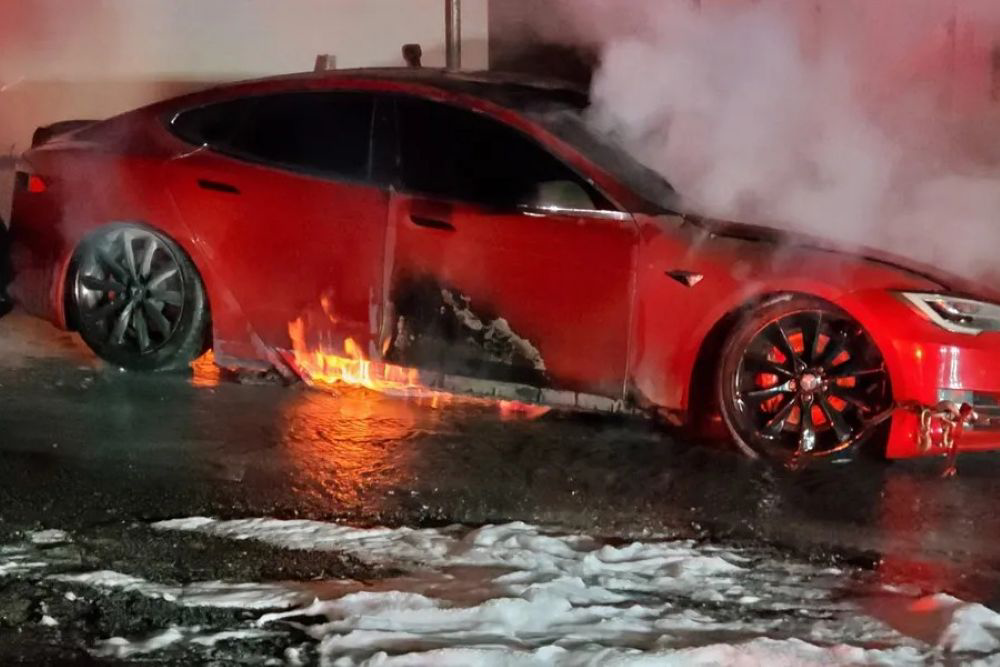

Saltwater-Soaked EVs Are Catching Fire Across Florida — And the Threat Is Growing
Why lithium-ion battery fires from storm-flooded electric vehicles should be on every Floridian's radar
As hurricane season looms once again over the Sunshine State, there's a danger lurking that many EV owners still don't fully understand: saltwater-submerged electric vehicles can spontaneously catch fire — sometimes days after a storm has passed.
A recent report from WTSP in Tampa sheds alarming light on this escalating issue. Florida's safety and insurance officials are now actively tracking EV fire incidents on a newly created public map, and the numbers are staggering.
The Numbers Don't Lie
Last year alone, Florida recorded 260 lithium-ion battery fires, with a heavy concentration in the Tampa Bay region. And 2025 is already off to a troubling start — 78 incidents have been logged before hurricane season has even begun.
When storm surges flood coastal neighborhoods, submerged electric vehicles — cars, golf carts, scooters, and more — can ignite without any warning whatsoever. In some cases, these fires have destroyed entire homes.
Tampa resident Craig Hantl, a Tesla owner who has weathered three hurricane seasons, admitted he only recently became aware of the danger.
"It's kind of startling to know salt water can spontaneously cause a fire," he said.
Why Does This Happen?
When saltwater infiltrates a lithium-ion battery pack, it can create short circuits within the individual cells. Salt is a highly effective conductor of electricity, and the resulting chemical reaction can generate intense, uncontrollable heat — leading to what's known as thermal runaway. Once thermal runaway begins, a lithium-ion battery fire burns at extreme temperatures, is incredibly difficult to extinguish with conventional methods, and can reignite hours or even days after being initially suppressed.
This is precisely why we at FireFibers are so passionate about lithium-ion fire preparedness. Traditional fire suppression tools were never designed for these types of chemical fires, and the risks are only increasing as EV adoption grows.
What Officials Are Advising
Florida authorities and local fire departments are urging EV owners to take proactive steps:
- Evacuate WITH your electric vehicle. Do not leave it behind in a flood zone.
- Never leave an EV plugged into a wall during a storm evacuation.
- Don't park EVs in enclosed parking areas where a fire could spread rapidly to structures or other vehicles.
- Seek higher ground. Some fire departments, like the Pinellas Park Fire Department, recommend temporarily parking EVs in public parking garages on elevated terrain during evacuations.
"If you have an electric vehicle, you need to know where you're going to store it during a storm. Higher ground is key," TJ Layfield with the Pinellas Park Fire Department advised.
The Insurance Landscape Is Shifting
Here's another critical piece of the puzzle that EV owners need to understand: while comprehensive auto insurance currently tends to cover EV fire damage related to storm surge, that may not last.
Insurance risk specialist Landon Cassidy noted that the surge in EV-related fire claims is already straining the insurance industry.
"So far, we haven't seen any consumers held liable for not relocating their EV. But that could change."
In other words, the day may come when failing to move your EV to safety before a storm could leave you financially exposed — with no insurance payout to cover the damage.
Be Prepared — Not Just for the Storm, but for What Comes After
At FireFibers, we believe that awareness is the first line of defense, but preparation is what actually saves lives and property. Lithium-ion battery fires behave differently than traditional fires. They burn hotter, they're harder to control, and they can reignite when you think the danger has passed.
That's why our lithium-ion fire blankets are designed specifically to address the unique thermal challenges posed by battery fires. Whether you're a homeowner in a flood-prone area, a fleet manager overseeing electric vehicles, or a first responder preparing for the worst, having the right suppression tools on hand can make the difference between a contained incident and a catastrophic loss.
The Bottom Line
The 2025 hurricane season is approaching fast. If you own an electric vehicle — or live near someone who does — now is the time to plan. Know where you'll move your EV. Know what coverage you carry. And make sure you have the right fire safety equipment in place for a threat that traditional tools simply weren't built to handle.
Don't wait for the next EV fire to be the one that changes everything for you.
Want to learn more about how FireFibers lithium-ion fire blankets can protect your home, garage, or fleet? Contact us today to discuss your fire safety needs.
Original story via WTSP Tampa Bay.